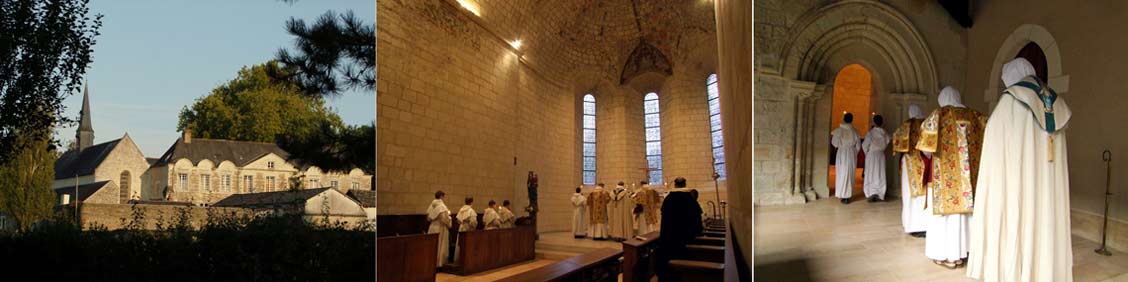
Presentation of Bishop Dom Thomas Aquinas O.S.B. (Part 1)


Presentation of Bishop Dom Thomas Aquinas O.S.B.  (Part 1)
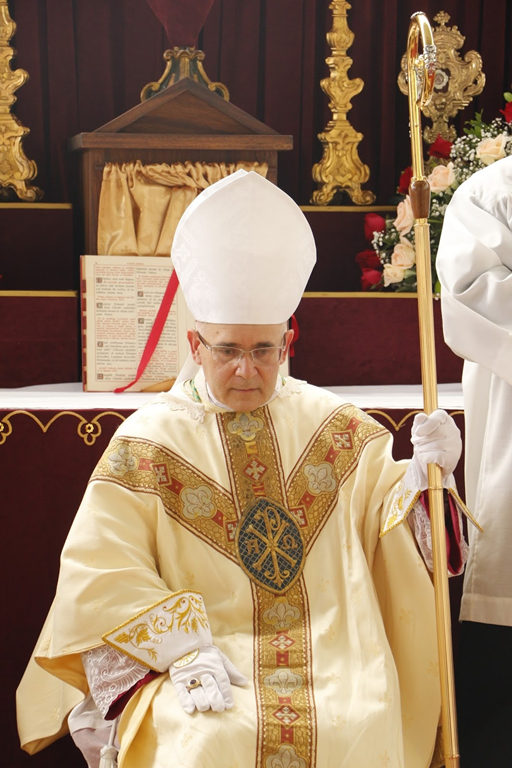
Miguel Ferreira da Costa (the future Father Thomas Aquinas) was born in Rio de Janeiro, Brazil in 1954.  He subsequently lived in Volta Redonda, where his father worked in an important steel factory, until 1962, when his family came back to Rio.  After his instruction at St. Benedict’s College in Rio de Janeiro, he started his studies in law.

Around the age of 13 he attended one of the weekly conferences given voluntarily by the anti-modernist writer Gustavo Corção to a little group of faithful, desiring to better know the treasures of the Catholic faith:

“I came back during 7 years, encouraged by my mother who barely missed any of these conferences.  My father always attended them when his work allowed him to.  It’s in that occasion that I had the chance to know Mr. Julio Fleichman and his wife, etc.1.” 

The young Miguel Ferreira da Costa went to see Gustavo Corção in 1972, to open his heart about his vocation and to ask him to which seminary he should go.  At this time, Gustavo Corção did not yet know Archbishop Lefebvre:

«”Tell you where to go?”, answered Gustavo Corção, “I can’t.  What I can tell you is where not to go.  You’ll have a hard time finding where they don’t teach fooly things […]”   It’s then that Mrs Pierotti, Corção’s secretary, spoke to me about Archbishop Lefebvre and Ecône: «If you were my son, that’s where I would send you».

Miguel Ferreira da Costa wrote to Archbishop Lefebvre who addressed him to the seminary of Bishop de Castro Mayer in Campos, a city in the State of Rio de Janeiro.  He went there, but he was discouraged by the influence of the TFP movement (“Tradition, Family, Property”) in the seminary.  Then, he heard about the priory that Dom Gérard founded in Bédoin, Provence (France), at the foot of Mount Ventoux.  Gustavo Corção told him: «Go there. If it’s not good, come back.»

“Without realizing it, he had made a prophecy, because that’s how this adventure was going to finish, through ways ordained “mightly and softly” by Divine Providence.  In the meantime, Dom Gérard wrote that he accepted me.  From Ecône arrived a letter too. The director of the seminary, the canon Berthod, opened his doors too.  To make a long story short, I went to Dom Gérard, which was not the best choice.”

Miguel Ferreira da Costa arrived in France in May 1974, in the little Provencal monastery of Bédoin, where Dom Gérard Calvet was following the traditional Benedictine monastic life since 1971.  On October 2, he received the religious habit along with the religious name of Thomas Aquinas, and started his novitiate.  On the occasion of his vows in 1976, Gustavo Corção came to the monastery to attend to the ceremony.  At that time Dom Gérard and the monks were united in heart and thought with Archbishop Lefebvre who gave the Holy Orders to the monks of the monastery.  In 1980, after his ordination in Ecône, Father Thomas Aquinas and the monks moved to the Barroux, leaving with sorrow, Bédoin, which had become too small.

Despite the enthusiasm which reigned at the monastery, Father Thomas Aquinas perceived a lack of philosophical and theological formation of the monks:

“There was already something very disturbing which explains, in my opinion, the drift which our community would have come to know some years later. […]  The formation given in Bédoin, when I arrived and until my ordination, was pretty informal.  Dom Gérard, it’s true, invited a few devoted and learned religious who came to give us some courses.

[…] But these conferences and even these courses didn’t form a structured whole, capable of giving us a true and solid formation. The courses, anyway, weren’t given in the correct order and, for the most part, they remained unfinished.  Dom Gérard then improvised the role of professor to teach us some treatises […] but in a too summarized way, sadly. He also asked the monks to give each other some of the courses when we weren’t yet capable enough to do so.  There were too few classes per week and the exams were very rare.  And so, many subjects were more or less unknown or misunderstood by the first generation of Bédoin. […]

Dom Gérard’s way of going about things was more artistic than realistic.  According to him, St. Thomas had his system.  Other people had others.  This left a doubt on the true value of a purely scholastic formation and of its real necessity, as St. Pius X presents it in the encyclical Pascendi, and in the Code of Canon Law. […] As a result, all we knew about the scholastic method was its name; and for the Summa Theologica, we learned the conclusions without understanding the argumentation.  We contemplated from the outside the Church’s beautiful doctrinal edifice without truly penetrating in the interior, and if at times we entered a bit it was as lay men and not as professionals.  One may say that the role of monks is not to become theologians, that contemplatives don’t need a lot of knowledge in order to devote themselves to contemplation.  That could be true in some cases but, if we were destined to the priesthood, if we were monks and priests, if among us some were destined one day to teach, then, it can hardly be conceived not to be formed in the method of St. Thomas, according to the directives of the Holy See, most especially in the actual crisis. […]

Without falling into the excess of saying that in Bédoin and Barroux we were modernists, it’s certain that we didn’t have in Dom Gérard the same purity, vigilance and doctrinal assurance of Archbishop Lefebvre.  If we weren’t modernists, the environment which reigned there didn’t protect us enough against their doctrines nor against a certain liberalism.”

It’s in 1975 that Father Thomas Aquinas saw for the first time Archbishop Lefebvre, who came to Bédoin to give the minor orders to the brothers Jean de Belleville and Joseph Vannier:

“The homily of Archbishop Lefebvre impressed me by its serenity. It radiated peace, that peace which is the motto of the Benedictines, and which he seemed to have more than us all.”

Father Thomas Aquinas attended at the ordinations in Ecône in 1976, which were a prelude to the «hot summer».  However, it wasn’t until the year of study and rest which he passed at the seminary St. Pius X in Ecône in 1984-1985, that he had a personal contact with Archbishop Lefebvre:

“Taking advantage of the presence of Archbishop Lefebvre, I could see him often.  His paternal goodness made his conversations easy. […]  On March 12, 1985, Archbishop Lefebvre spoke to me about the question of an agreement with Rome.

I think Archbishop Lefebvre broached this topic because of Dom Gérard who, at that time, […] was trying to obtain the support of Archbishop Lefebvre for what he wanted to do.”

Thanks to the notes that he had the habit of writing up after each meeting, Father Thomas Aquinas reveals to us some enlightening words of Archbishop Lefebvre:

“Be subject to men who have not the fullness of the Catholic faith?  Submit to men who proclaim principles contrary to the principles of the Church?  Either we will be obliged to break with them once more and the situation will become worse than before or we will be lead imperceptibly to the lessening and to the loss of the faith.  There is also a third possibility.  A very difficult life because of frequent contact with men who do not have the Catholic faith, leading to the disorientation and to the decrease of the spirit of combat of the faithful.(..)  Our position, such as it is now, allows us to remain united in the faith.  All those who have wanted to compromise with the modernists have veered off course.  I think that we must not submit to them.  I am very distrustful.  I spend whole nights thinking about that.  It is not we who must sign something.  It is they who must sign something guaranteeing that they accept the doctrine of the Church.  They want our submission but they do not give us doctrine.”

Reverend Father Thomas Aquinas also noted that as early as 1984 or 85, Dom Gérard went to Rome to negotiate for the regularization of the monastery of Le Barroux:

He went to see Cardinal Ratzinger and came back dazzled by him. ²The Cardinal, he said, is someone with whom one can work.  Archbishop Lefebvre is too withdrawn.”   And he imitated the attitude of the Archbishop as someone sulking in his corner.  “Moreover it is not necessary that it be Archbishop Lefebvre who ordains our priests.  Another bishop can do it just as well, provided that it is with the old rite”.  We had cold shivers down our backs when we heard all that. (…)  At the end of 1986, I set off for Brazil with Father Joseph Vannier to look at a plot of land with a view to a new foundation.  I was rather relieved to be leaving Le Barroux where the atmosphere was becoming more and more oppressive.  You could feel that the monastery was on a slippery slope.

On May 3rd, 1987 the monastery of Santa Cruz was officially founded and Father Thomas Aquinas became the prior.  The monastery is situated near Nova Friburgo, a town situated in the north-central part of the State of Rio de Janeiro.  Relations between the new foundation and Le Barroux deteriorated rapidly as Dom Thomas Aquinas recounts:

“Next came the years of the foundation of Santa Cruz, during which time Archbishop Lefebvre helped us with his precious counsel.  My conscience was very disturbed because of the liturgical modifications introduced into the Mass by Dom Gérard.[…]  So I wrote to Archbishop Lefebvre who, although not approving Dom Gérard, advised me to maintain good relations with the monastery of Le Barroux in France.  But these good relations with our monastery in France were not going to last long.  Dom Gérard, after the consecrations, was to make an agreement which was going to put our monasteries under the authority of the modernists.”

Here is the judgment of Father Thomas Aquinas on Le Barroux and its founder:

“In this way Dom Gérard destroyed his work.  This work, despite its deficiencies, was for all that a beautiful work .  The offices were said there with much care, the monastic virtues were held in honour there and we had very good vocations which came to us from families who were truly Catholic and traditional.  Dom Gérard had wanted to form a traditional monastery but he lacked an in-depth understanding of the present crisis. Dom Gérard saw the necessity of keeping the Mass of all-time; of keeping the monastic observances but he did not see with sufficient clarity the dangers of modernism and liberalism.  The most profound aspect of the present crisis eluded him.  All that allows us to measure more accurately the value of Archbishop Lefebvre and his work.  It is the Archbishop who saw correctly, it is he who discerned the evil, it is he who understood all the gravity of the situation.  The Archbishop had a vision of faith, a vision which was theological in the most precise sense of the word.  This was lacking in Dom Gérard who, like Jean Madiran, saw the defection of the diocesan bishops rather than that of the conciliar Popes, alas.[…]  When the news of the agreements reached us, we were already expecting it.  At first we thought of leaving Santa Cruz and leaving everything for Dom Gérard and those who wanted to follow him2.

A letter from Archbishop Lefebvre made us change our minds and we kept Santa Cruz in the bosom of Tradition.  […]  Dom Gérard, when he came to Brazil, had to leave again without obtaining what he was hoping for.  After these painful events we had no more contact with him.  On the other hand Archbishop Lefebvre became more and more what he is for all faithful Catholics, i.e. the faithful successor of the apostles who gave us the doctrine and the sacraments of Our Lord Jesus Christ for the salvation of our souls.  To him we owe our eternal gratitude.

August 18, 1988 Archbishop Lefebvre wrote a letter to Father Thomas Aquinas in which he said:

” How much I regretted that you had left before the events at Le Barroux3.  It would have been easier to consider the situation provoked by Dom Gérard’s disastrous decision. […]  Dom Gérard, in his declaration, reports what is given to him and accepts putting himself under obedience to modernist Rome, which remains fundamentally anti-traditional, which was the cause of my estrangement.  At the same time he would like to keep the friendship and support of traditionalists, which is inconceivable.  He accuses us of ” resistance-ism”.  Yet I warned him. But his decision was taken a long time ago and he no longer wanted to listen to reason.  From now on the consequences are inescapable.  We will have no further links with Le Barroux and we will warn all our faithful to no longer support a work which is now in the hands of our enemies, the enemies of Our Lord and His universal Reign.

The Benedictine sisters are in anguish.  They came to see me.  I advised them what I advise you also: keep your liberty and refuse all links with this modernist Rome.  Dom Gérard uses all the arguments to lull the resisters. […]  You should have a meeting with Fathers Laurent and the Argentinian Father John of the Cross as well as with the novices.  With the three of you and the novices of Campos you can continue and constitute a monastery independent of Rome.  You must not hesitate to affirm this publicly.  God will bless you.  And you could then, after some time, set up a monastery again in France, you would be very well supported and would have vocations.  Dom Gérard has killed his own work.  Father Tam will tell you in person what I have not written.  I beg Our Lady to come to your aid in defence of the honour of her divine Son.  May God bless you and your monastery.”
(To be continued)


62 Reasons to reject the new mass (“Novus Ordo Missae”)


62 Reasons to Reject the new mass (“Novus Ordo Missae”)

NOTES OF THE EDITOR :

1. These 62 reasons have been written by the priests of Campos (Brazil) before they dangerously accepted a canonical recognition by the conciliar Church.

The new mass can be valid when it is celebrated by a priest validly ordained, saying the prayers of the consecration on bread and wine with the intention to perform what the holy Church intends to perform. It is not always the case.

But these 62 reasons show that, even validly celebrated, the new mass cannot be said to be good by itself. By itself, it doesn’t objectively honor God as He should be honored ; and having been made with six Protestant pastors, it is dangerous for the Faith.

What is not good in itself cannot bear good fruit by itself. If sometimes there are good fruit, it is only accidental ; and it is not a reason to attend it actively.

2. Note: all quotes followed by an asterisk * are from the Letter of Cardinals A. Ottaviani and A. Bacci to Pope Paul VI, dated September 25, 1969 enclosing “A Critical Study of the Novus Ordo Missae.”

1. Because the New Mass is not an unequivocal Profession of the Catholic Faith (which the traditional Mass is), it is ambiguous and with a Protestant flavor. Therefore since we pray as we believe, it follows that we cannot pray with the New Mass in Protestant fashion and still believe as Catholics!

2. Because the changes were not just slight ones but actually “deal with a fundamental renovation … a total change … a new creation.” (Msgr. A. Bugnini, co-author of the New Mass)

3. Because the New Mass leads us to think “that truths … can be changed or ignored without infidelity to that sacred deposit of doctrine to which the Catholic Faith is bound forever.” *

4. Because the New Mass represents “a striking departure from the Catholic theology of the Mass as formulated in Session XXII of the Council of Trent” which, in fixing the “canons,” provided an “insurmountable barrier to any heresy against the integrity of the Mystery.” *

5. Because the difference between the two is not simply one of mere detail or just modification of ceremony, but “all that is of perennial value finds only a minor place (in the New Mass), if it subsists at all.” *

6. Because “Recent reforms have amply demonstrated that fresh changes in the liturgy could lead to nothing but complete bewilderment in the faithful who already show signs of uneasiness and lessening of Faith.”

7. Because in times of confusion such as now, we are guided by the words of our Lord: “By their fruits you shall know them.” Fruits of the New Mass are: 30% decrease in Sunday Mass attendance in U.S. (NY Times, 5/24/75), 43% decrease in France (Cardinal Marty), 50% decrease in Holland (NY Times, 1/5/76).

8. Because “amongst the best of the clergy the practical result (of the New Mass) is an agonizing crisis of conscience…”*

9. Because in less than seven years after the introduction of the New Mass, priests in the world decreased from 413,438 to 243,307 – almost 50%! (Holy See Statistics)

10. Because “The pastoral reasons adduced to support such a grave break with tradition … do not seem to us sufficient.” *

11. Because the New Mass does not manifest Faith in the Real Presence of our Lord – the Traditional Mass manifests it unmistakably.

12. Because the New Mass confuses the REAL Presence of Christ in the Eucharist with His MYSTICAL Presence among us (proximating Protestant doctrine).

13. Because the New Mass blurs what ought to be a sharp difference between the HIERARCHIC Priesthood and the common priesthood of the people (as does Protestantism).

14. Because the New Mass favors the heretical theory that it is THE FAITH of the people and not THE WORDS OF THE PRIEST which makes Christ present in the Eucharist.

15. Because the insertion of the Lutheran :”Prayer of the Faithful” in the New Mass follows and puts forth the Protestant error that all the people are priests.

16. Because the New Mass does away with the Confiteor of the priest, makes it collective with the people, thus promoting Luther’s refusal to accept the Catholic teaching that the priest is judge, witness and intercessor with God.

17. Because the New Mass gives us to understand that the people concelebrate with the priest – which is against Catholic theology!

18. Because six Protestant ministers collaborated in making up the New Mass: George, Jasper, Shepherd, Kunneth, Smith and Thurian.

19. Because just as Luther did away with the Offertory – since it very clearly expressed the sacrificial, propitiatory character of the Mass – so also the inventors of the New Mass did away with it, reducing it to a simple Preparation of the Gifts.

20. Because enough Catholic theology has been removed that Protestants can, while keeping their antipathy for the True Roman Catholic Church, use the text of the New Mass without difficulty. Protestant Minister Thurian (co-consultor for the ‘New Mass’ project) said that a fruit of the New mass “will perhaps be that the non-Catholic communities will be ale to celebrate the Lord’s Supper using the same prayers as the Catholic Church.” (La Croix, 4/30/69)

21. Because the narrative manner of the Consecration in the New Mass infers that it is only a memorial and not a true sacrifice (Protestant thesis)

22. Because by grave omissions, the New Mass leads us to believe that it is only a meal (Protestant doctrine) and not a sacrifice for the remission of sins (Catholic Doctrine).

23. Because the changes such as: table instead of altar; facing people instead of tabernacle; Communion in the hand, etc., emphasize Protestant doctrines (e.g., Mass is only a meal; priest only a president of the assembly; Eucharist is NOT the Body, Blood, Soul and Divinity of Jesus Christ, but merely a piece of bread, etc.)

24. Because Protestants themselves have said “the new Catholic Eucharistic prayers have abandoned the false (sic) perspective of sacrifice offered to God.” (La Croix, 12/10/69)

25. Because we are faced with the dilemma: either we become protestantized by worshipping with the New Mass, or else we preserve our Catholic Faith by adhering faithfully to the traditional Mass, the “Mass of All Time.”

26. Because the New Mass was made in accordance with the Protestant definition of the Mass: “The Lord’s Supper or Mass is a sacred synaxis or assembly of the people of God which gathers together under the presidency of the priest to celebrate the memorial of the Lord.” (Par. 7, Intro. to the New Missal, defining the New Mass, 4/6/69)

27. Because by means of ambiguity, the New Mass pretends to please Catholics while pleasing Protestants; thus it is “double-tongued” and offensive to God who abhors any kind of hypocrisy: “Cursed be … the double-tongued for they destroy the peace of many.” (Ecclesiasticus 28:13)

28. Because beautiful, familiar Catholic hymns which have inspired people for centuries, have been thrown out and replaced with new hymns strongly Protestant in sentiment, further deepening the already distinct impression that one is no longer attending a Catholic function.

29. Because the New Mass contains ambiguities subtly favoring heresy, which is more dangerous than if it were clearly heretical since a half-heresy half resembles the Truth!

30. Because Christ has only one Spouse, the Catholic Church, and her worship service cannot also serve religions that are at enmity with her.

31. Because the New Mass follows the format of Cranmer’s heretical Anglican Mass, and the methods used to promote it follow precisely the methods of the English heretics.

32. Because Holy Mother Church canonized numerous English Martyrs who were killed because they refused to participate in a Mass such as the New Mass!

33. Because Protestants who once converted to Catholicism are scandalized to see that the New Mass is the same as the one they attended as Protestants. One of them, Julien Green, asks: “Why did we convert?”

34. Because statistics show a great decrease in conversions to Catholicism following the use of the New Mass. Conversions, which were up to 100,000 a year in the U.S., have decreased to less than 10,000! And the number of people leaving the Church far exceeds those coming in.

35. Because the Traditional Mass has forged many saints. “Innumerable saints have been fed abundantly with the proper piety towards God by it …” (Pope Paul VI, Const. Apost. Missale Romanum)

36. Because the nature of the New Mass is such as to facilitate profanations of the Holy Eucharist, which occur with a frequency unheard of with the Traditional Mass.

37. Because the New Mass, despite appearances, conveys a New Faith, not the Catholic Faith. It conveys Modernism and follows exactly the tactics of Modernism, using vague terminology in order to insinuate and advance error.

38. Because by introducing optional variations, the New Mass undermines the unity of the liturgy, with each priest liable to deviate as he fancies under the guise of creativity. Disorder inevitably results, accompanied by lack of respect and irreverence.

39. Because many good Catholic theologians, canonists and priests do not accept the New Mass, and affirm that they are unable to celebrate it in good conscience.

40. Because the New Mass has eliminated such things as: genuflections (only three remain), purification of the priests fingers in the chalice, preservation from all profane contact of priest’s fingers after Consecration, sacred altar stone and relics, three altar clothes (reduced to one), all of which “only serve to emphasize how outrageously faith in the dogma of the Real Presence is implicitly repudiated.” *

41. Because the traditional Mass, enriched and matured by centuries of Sacred Tradition, was codified (not invented) by a Pope who was a saint, Pius V; whereas the New Mass was artificially fabricated by six Protestant ministers and Msgr. Annibale Bugnini suspect of being a Freemason.

42. Because the errors of the New Mass which are accentuated in the vernacular version are even present in the Latin text of the New Mass.

43. Because the New Mass, with its ambiguity and permissiveness, exposes us to the wrath of God by facilitating the risk of invalid consecrations: “Will priests of the near future who have not received the traditional formation, and who rely on the Novus Ordo Missae with the intention of ‘doing what the Church does,’ consecrate validly? One may be allowed to doubt it!” *

44. Because the abolition of the Traditional Mass recalls the prophecy of Daniel 8:12: “And he was given power against the perpetual sacrifice because of the sins of the people” and the observation of St. Alphonsus de Liguori that because the Mass is the best and most beautiful thing which exists in the Church here below, the devil has always tried by means of heretics to deprive us of it.

45. Because in places where the Traditional Mass is preserved, the Faith and fervor of the people are greater. Whereas the opposite is true where the New Mass reigns (Report on the Mass, Diocese of Campos, Roma, Buenos Aires #69, 8/81)

46. Because along with the New Mass goes also a new catechism, a new morality, new prayers, new Code of Canon law, new calendar, — in a word, a NEW CHURCH, a complete revolution from the old. “The liturgical reform … do not be deceived, this is where the revolution begins.” (Msgr. Dwyer, Archbishop of Birmingham, spokesman of Episcopal Synod)

47. Because the intrinsic beauty of the Traditional Mass attracts souls by itself; whereas the New Mass, lacking any attractiveness of its own, has to invent novelties and entertainment in order to appeal to the people.

48. Because the New mass embodies numerous errors condemned by Pope St. Pius V at the Council of Trent (Mass totally in vernacular, words of Consecration spoken aloud, etc. See Condemnation of Jansenist Synod of Pistoia), and errors condemned by Pope Pius XII (e.g., altar in form of table. See Mediator Dei).

49. Because the New Mass attempts to transform the Catholic Church into a new, ecumenical church embracing all ideologies and all religions – right and wrong, truth and error – a goal long dreamt of by the enemies of the Catholic Church.

50. Because the New Mass, in removing the salutations and final blessing when the priest celebrates alone, shows a denial of, and disbelief in the dogma of the Communion of Saints.

51. Because the altar and tabernacle are now separated, thus marking a division between Christ in His priest-and-Sacrifice-on-the-altar, from Christ in His Real Presence in the tabernacle, “two things which of their very nature, must remain together.” (Pius XII)

52. Because the New Mass no longer constitutes a vertical worship between God and man, but rather a horizontal worship between man and man.

53. Because the New Mass, although appearing to conform to the dispositions of Vatican Council II, in reality opposes its instructions, since the Council itself declared its desire to conserve and promote the Traditional Rite.

54. Because the Traditional Latin Mass of Pope St. Pius V has never been legally abrogated and therefore remains a true rite of the Roman Catholic Church by which the faithful may fulfill their Sunday obligation.

55. Because Pope St. Pius V granted a perpetual indult, valid “for always,” to celebrate the Traditional Mass freely, licitly, without scruple of conscience, punishment, sentence or censure (Papal Bull Quo Primum)

56. Because Pope Paul VI, when promulgating the New Mass, himself declared. “The rite … by itself is NOT a dogmatic definition …” (11/19/69)

57. Because Pope Paul VI, when asked by Cardinal Heenan of England, if he was abrogating or prohibiting the Tridentine Mass, answered: “It is not our intention to prohibit absolutely the Tridentine Mass.”

58. Because “In the Libera nos of the New Mass, the Blessed Virgin, the Apostles and all the Saints are no longer mentioned; her and their intercession thus no longer asked, even in time of peril.” *

59. Because in none of the three new Eucharistic Prayers (of the New Mass) is there any reference … to the state of suffering of those who have died, in none the possibility of a particular Memento, thus undermining faith in the redemptive nature of the Sacrifice. *

60. Because we recognize the Holy Father’s supreme authority in his universal government of Holy Mother Church, but we know that even this authority cannot impose upon us a practice which is so CLEARLY against the Faith: a Mass that is equivocal and favoring heresy and therefore disagreeable to God.

61. Because, as stated in Vatican Council I, the “Holy Spirit was not promised to the successors of Peter, that by His revelation they might make new doctrine, but that by His assistance they might inviolably keep and faithfully expound the revelation or deposit of Faith delivered through the Apostles.” (Dnz 3070)

62. Because heresy, or whatever clearly favors heresy, cannot be a matter for obedience. Obedience is at the service of Faith and not Faith at the service of obedience! In this foregoing case then, “One must obey God before men.” (Acts 5:29)

A simple method to pray the Rosary without distractions (continued): the Glorious Mysteries


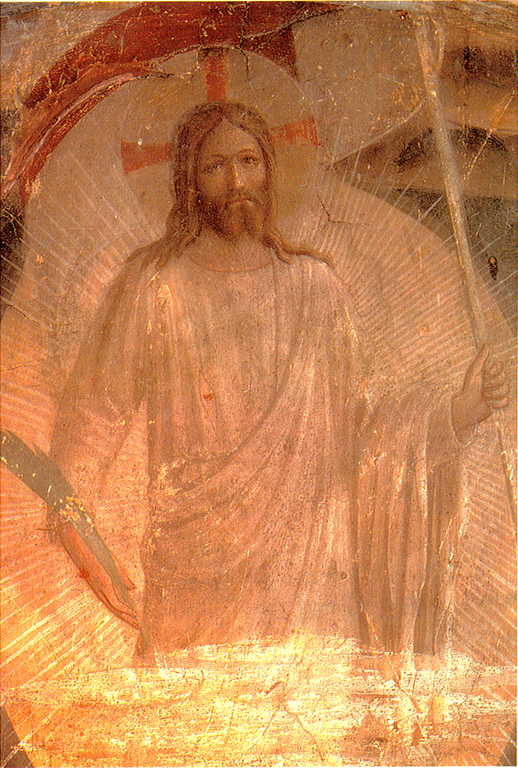
The Resurrection by Fra Angelico

A simple method to pray the Rosary without distractions (continued): the Glorious Mysteries

The Rosary is an admirable means of personal sanctification, but it is also a powerful weapon again the enemies of God and His Church. From the defeat of the Cathars at the battle of Muret to the great victories (without a shot being fired!) against communism in Austria and Brazil in the 20th Century, and passing through the victories of Lepanto and Vienna against the Turks, and those against the Protestants in La Rochelle, the Most Holy Virgin has never abandoned Catholics when they have turned to her through her holy Rosary. However, this ancient struggle between the “lineage of the serpent and the lineage of the woman” is renewed with each generation.

This struggle is perhaps nowhere more manifest at this time than in the past. Although it is not the objective of the Confraternity to convey prayer intentions to the members, how can we keep quiet in the face of the drama that is now unfolding for our Catholic brothers being persecuted in Syria, Iraq and Egypt, as well as in China, Nigeria, India and elsewhere? Through the Rosary, let us pray for the conversion of the Muslims, Jews, Protestants, communists, freemasons, and all those who are behind these persecutions. Let us especially pray that the persecuted Catholics keep the faith and publicly profess it, even, if need be, at the price of their life. We can hope that a host of these chosen souls have received the grace of martyrdom, are already in heaven tasting the delights of paradise, and that we whom they have left behind in this valley of tears, can join with them by meditating on the Glorious Mysteries, after having considered the Joyous and Sorrowful Mysteries.

(Remember: read one sentence before each “Hail Mary.”)

THE RESURRECTION

1. Upon His death, Jesus’ soul descends into limbo to the joy of the just of the Old Testament.

2. His lifeless body remains in the tomb, always united to the divinity, without the least corruption.

3. On Easter morning, Jesus’ soul reunites with His body, never to be separated from it again.

4. His body, brilliant with light, imprints a mysterious image on the holy shroud.

5. At the same time, the earth is shaken and an angel rolls away the great stone that closed the tomb.

6. Jesus leaves the tomb in all His glory and appears to the Roman soldiers, who are terrified.

7. Jesus goes to visit the Blessed Virgin to announce His Resurrection to her.

8. The Blessed Virgin is filled with joy, but is by no means surprised, nor troubled; she had been waiting for this moment since Good Friday.

9. Jesus appears to St. Mary Magdalene and tells her, “do not touch me” to test her too sentimental love.

10. Jesus appears several times to the Apostles and the disciples, but some are slow to believe.

THE ASCENSION

1. At Jesus’ resurrection, many of the dead leave their tombs and roam around the city of Jerusalem.

2. During the forty days, they visit their families to proclaim to them that Jesus is the Messiah announced by the prophets.

3. Jesus appears only to His Apostles and disciples.

4. Jesus “opens the minds” of His Apostles so that, little by little, they come to understand Holy Scripture.

5. A little before ascending to heaven, Jesus orders His Apostles to “teach ye all nations; baptizing them in the name of the Father, and of the Son, and of the Holy Ghost. Teaching them to observe all things whatsoever I have commanded you.” (Matt. 28:19-20)

6. The nations must render public honor to Our Lord Jesus Christ, and all of society’s laws must be in harmony with His teachings.

7. Jesus appears one last time in Jerusalem and eats with His Apostles.

8. He promises to send them the Holy Ghost.

9. He leads them to the Mount of Olives.

10. Jesus raises His hands and blesses His Apostles, all while moving away from them up to heaven.

PENTECOST

1. The Apostles are distraught.

2. Everyone returns to the Cenacle to pray and wait for the Holy Ghost.

3. The Apostles, the disciples and the holy women number about 120 persons.

4. Matthias is elected to replace the traitor Judas.

5. St. Peter says Mass each day. All receive communion and passes the day in prayer.

6. During this time, an innumerable crowd of Jews from throughout the world is assembling in the city to celebrate the feast of the Jewish Pentecost.

7. Suddenly, accompanied by the sound of trumpets, a violent wind opens the windows of the Cenacle.

8. Tongues of fire descend upon the heads of the Apostles, and, in the blink of an eye, they understand all of Jesus’ teachings.

9. Immediately they descend into the street to announce to the crowd the forgiveness of their sins, upon the condition of doing penance and being baptized.

10. Around 3,000 people ask to be baptized.

THE ASSUMPTION

1. Each day more and more people ask for baptism so as to be saved, but the jealous Jews try to exterminate the Christians.

2. St. Stephen, St. James the Lesser and many others are killed in hatred of the faith.

3. Mary supports the nascent Church through her prayers.

4. St. Luke questions the Blessed Virgin on the details of Jesus’ infancy.

5. The Blessed Virgin receives daily communion at St. John’s Masses.

6. She appears to St. James the Greater in Spain to encourage him.

7. She enlightens and encourages all those who come to see her at St. John’s home.

8. She so ardently desires to be with her divine Son, that her body can no longer retain her soul.

9. Her soul and her body separate, but her body suffers no trace of corruption.

10. A little afterward, her body rejoins her soul and the Blessed Virgin is assumed entirely into heaven.

THE CORONATION OF THE BLESSED VIRGIN

1. At the moment of her Immaculate Conception, the Blessed Virgin exceeded in grace all the angels and saints combined.

2. During each moment of her existence, she made an act of love which multiplied in an extraordinary way the degree of grace in her soul.

3. Thus, at the moment of her entry into heaven, the Blessed Virgin was raised in glory higher than one can imagine.

4. Her glory is quasi-infinite; she touches the “confines of the divinity.”

5. Our Lord places a mysterious crown on the head of His Blessed Mother.

6. This crown symbolizes the total power with which the Blessed Virgin is invested from that point on.

7. Jesus proclaims the Blessed Virgin, “Queen of Heaven and Earth.”

8. All the angels and saints acclaim her as their queen and mistress.

9. Jesus desires that all the graces that we receive pass through Mary’s hands.

10. Mary now distributes all the graces that she has merited with and through Jesus at the foot of the Cross.

An Interview with Fr. Thomas Aquinas, OSB


An Interview with Fr. Thomas Aquinas, OSB

Translated from the original Portuguese by Michael Fuller

1. Reverend Father, why is another Bishop needed for the Resistance? Does a state of necessity subsist in the Church? Aren’t the traditionalist bishops of the SSPX enough for the Church, as the SSPX states?

The Church needs Bishops because Our Lord wanted it like this.  So, Tradition needs Bishops. The work that Bishop Williamson has done since 1988 is enormous. The help that Bishop Faure brings is indispensable, and a third bishop is not too much.  Tradition came to count with seven bishops when Bishop Lazo from the Philippines came over to Tradition before the deaths of Archbishop Lefebvre and Bishop De Castro Mayer.  The Resistance is nothing more than the continuance of Tradition.

2. Some people say that your consecration will constitute a schismatic act. What can you say in this regard?

Just like the 1988 consecrations did not constitute a schismatic act, in the same way, this one also will not.   The reason that motivated the first consecrations is the same that motivates the other ones, that is, the fact that Rome does not return to Tradition.

Evidently, this new consecration can receive criticism, just like the consecration of Bishop Faure, but for those that attentively consider the reasons, it concerns consecrations motivated by the very same motive of the 1988 ones: the fact that the Basilica of St. Peter is occupied by enemies of the Our Lord.  It’s a painful fact, but it is fact.  To deny it proves to be unrealistic, an accusation made by Bishop Fellay to his three brothers of the episcopacy: Bishops Williamson, Tissier, and de Galarreta (Letter of April 14, 2012).

This new consecration is motivated by nothing more than the same motives that made Archbishop Lefebvre act, nothing more and nothing less.  The only difference is the special circumstance in relation to the authorities of the Society; but in relation to Rome and the crisis, the reasons are the same and are identical in every way.

3. Father, last year, motivated by the consecration of Bishop Faure, the SSPX said that the Resistance is sedevacantist and that that is demonstrated by consecrating bishops without the permission of the Roman authorities. What is your response to this other accusation?

In the very same way that Archbishop Lefebvre was not a sedevacantist, the Resistance is not sedevacantist, although within the Resistance there may be, just like in the SSPX there always were, sympathizers of this thesis.

4. Father, what is your position regarding sedevacantism?

I think that the position of Archbishop Lefebvre in this regards is the most sensible and the most prudent.  The Pope cannot use his authority to destroy the Church, so we don’t obey him in this work. We refuse to have any part in the destruction of the Church.  As far as deciding if the Pope has lost his pontificate because of this, it is a disputed issue.  We don’t have the means of withdrawing a conclusion that eliminates all doubt.  So then, with doubt, it is best to not affirm that the seat is vacant and continue to consider him the Pope.

5. Last year we asked Bishop Faure what he would do if he were invited to the Vatican by Pope Francis. Now we ask you the same question. Would you go? What would you say to Francis?

Go to Rome?  Only if it were to ask if the Roman authorities accept Quanta Cura, Syllabus, Pascendi, etc., but for now I think that the answer was already given and it is negative.

6. Professor Carlos Nougué has posted a brief article about your life where he mentions the incident of the pressure you received from the authorities of the SSPX for having refused to sing the Te Deum in celebration of the Motu Proprio Summorum Pontificum (July of 2007). Can you tell us anything about this and about other circumstances when you were under pressure by the leaders of the SSPX?

What happened in Santa Cruz when Bishop de Galarreta was here suggesting to me that I leave the monastery is very complicated.  Several factors come about.  Only Bishop de Galarreta can say exactly what all the reasons were that moved him to make this suggestion to me.  The doctrinal question could have been in play, but there is no certainty about that since Bishop de Galarreta was, in principle, against the deal.  May be the liberty and independence of the monastery was unsettling to Bishop Fellay.  Bishop de Galarreta gave as a motive the vocations of the monastery because while I was prior, the priests would not send vocations.

7. Reverend Father, did your experience in the monastery of Le Barroux serve to strengthen your opposition to the going astray of the accordista drift or rallié of the SSPX?

Yes, there is something similar in the admiration that Dom Gérard had for the then Cardinal Ratzinger and the admiration, or at least, consideration that Bishop Fellay has for Benedict XVI.

Dom Gérard used to say that Archbishop Lefebvre stayed in his corner in order to refuse to come in contact with the Roman representatives and that Cardinal Ratzinger was a man that it would be possible to deal with.   Dom Gérard did not know the Cardinal and did not want to learn from the experience of Archbishop Lefebvre.  I think that Bishop Fellay has committed the same error.  The advice and views of elders is something fundamental in life.  Saint Thomas Aquinas, when speaking about docility, points to this disposition of the soul that we must have with elders.  It is worth reading article 3 of the question 49 of the IIa-IIae of the Summa Theologica.  It is very instructive.  Dom Gérard did not take into account the advice and warnings of Archbishop Lefebvre.  Bishop Fellay would act very differently if he also contemplated this, I believe.  This question deserves an entire study regarding the attitudes of Dom Gerard and Bishop Fellay.  I think that both were lacking in the prudence of Archbishop Lefebvre.

8. Can you tell us how the split came about between your monastery and the SSPX in 2012?

The separation between our monastery and the Society was gradual due to another incident.  But in 2012, when Brother Arsenio as well as myself wrote to them about the dealings with Rome, and moreover when Bishop Williamson was in our monastery and received our total support, the rupture was made.

Nevertheless, we maintain good relations with some members of the SSPX that see the problem, although they believe that it is better to remain in the SSPX for now.

9. Father, you knew Archbishop Lefebvre. Can you tell us something about him?

Archbishop Lefebvre possessed the strength and the tranquility of those that are certain about the well founded principles of what they are doing, and this was united to a great readiness to attend to souls.  His tranquility came from the robustness of his Faith and his common sense.  Certitude generates tranquility, so the certitude of Faith is superior to everything else.  From this we can see the total tranquility that Archbishop Lefebvre presented in every occasion.  He was a true bishop, as Saint Paul describes it, who acted in a way to save his own soul and the souls of others that listened to his words and counsel.  His motto from his coat of arms summed up his attitude and his action: Credidimus Caritati.

10. How would you explain the change that has been done in the SSPX regarding a practical agreement with Rome and what do you think with happen to the Society?

I think that there are members of the Society that want an agreement and have been working in this sense for many years.

Maybe Bishop Tissier de Mallerais and Bishop de Galerreta accepted the change from what had been decided in the 2006 General Chapter in order to save the Society from an internal division.

Only God knows what will happen with the Society.  I pray that it returns to its past fervor, but it will be difficult to return as things once were.

Not being together with the Society, I have difficulty in giving a fundamental opinion.  From what I have heard and read, I believe that the Society will try to arrive at an unstable equilibrium composed of legality and fidelity.  But they will fight on the turf chosen by the enemy.  From a tactical perspective, it’s not very smart.  The liberty to preach against the Holy See will be paralyzed.  Even more so, Bishop Fellay seems to think differently from Archbishop Lefebvre, despite his denial of this.  This is fatal for the SSPX.

11. Reverend Father, can we speak of a true and actual liberalism within the SSPX or would that be an exaggeration?

In bringing oneself closer to Rome, there is no way of avoiding liberalism.

12. Father, how would you define the Resistance and how do you see its future?

I would define the Resistance as fidelity to Archbishop Lefebvre and Bishop De Castro Mayer.  The resistance is Tradition, or is the most sane part of Tradition or, at least, the part of Tradition that clearly rejects the idea of a practical agreement without Rome having returned to Tradition.

The future of the Resistance is the fidelity to Archbishop Lefebvre and Bishop De Castro Mayer, or in other words, the teachings of the infallible Magisterium of the Church.  Thank God that we have Bishop Williamson and Bishop Faure with us because they were chosen by Archbishop Lefebvre and were always faithful disciples of the founder of the Society of St. Pius X.

13. What will be your priorities as bishop?

To give the Sacraments and assure the preaching of the Faith.

14. What will be the motto of your coat of arms and its meaning?

The motto will be “Veritatem Dilexisti” (Thou hast loved Truth) taken from Psalm 50.

The coat of arms is the backside of a miraculous medal with the 12 stars (the 12 articles of the Creed and the 12 Apostles), the Cross, the “M” of the Most Blessed Virgin Mary, and the Sacred Hearts.

In the beginning, Brazil had the name of the “Land of the Holy Cross”.  This is also the name of our monastery.

Our Congregation was dedicated to the Most Sacred Hearts of Jesus and Mary by our founder, Rev. Fr. Jean Baptiste Muard OSB, in the 19th century.

15. Finally, Reverend Father, would you like to send a message to traditionalists, in particular, to the Resistance?

A message?  Study the works of Archbishop Lefebvre and learn from his examples.  Archbishop Lefebvre is another Fr. Le Floch and Fr. Le Floch is the Magisterium; he is the love of the Magisterium of the Church.  Only in this way can liberalism and Modernism be overcome.

Moreover, read and search for understanding in the great anti-liberal authors, especially those that understand the errors of the modern world, like Bishop De Castro Mayer, Archbishop Lefebvre and also Bishop Tissier de Mallerais who expounds upon the strange theology of Benedict XVI with precision and who gave us the biography of Archbishop Lefebvre, not to mention the ancient authors, whose list would be too lengthy here.  Remember Bishop Vital, the great Brazilian bishop and friend of Msgr. de Ségur, who vigorously combated masonry and because of this was incarcerated and probably poisoned because he died a little after having been released from prison due to serious digestive problems.  Remember also Cardinal Pie and, for Brazilians, Gustavo Corção, whose book, “O Século do Nada” (The Age of Nothing), should be known by all. Corção understood the evil of the times very well: the lie, since he said that the 20th century could be called the age of the lie.  The remedy to this is in its opposite: “Veritatem dilexisti“.

Dear Father, we give enormous thanks to God, His Most Holy Mother, saint Joseph Protector of the Church, and saint Benedict for the great blessing that the Resistance receives with your consecration. We ask God to give you a highly fruitful episcopacy. We give many thanks to you for having accepted such an important responsibility and to Bishop Williamson and Bishop Faure because they will consecrate you as a successor of the Apostles. Deo grátias!

The False Mercy of Pope Francis


The False Mercy of Pope Francis

by Alexandre Marie

Last April, by the bull of indiction Misericordiae Vultus, Francis announced an “extraordinary jubilee of mercy”.

This “Holy Year” opened on December 8th 2015 to coincide with the fiftieth anniversary of the closing of the second Vatican council.  This year of mercy, Francis explained, is meant to celebrate the triumph of Vatican II, the beginning of a new era in the history of the Church:

“The Church feels the need to keep this event alive.  It is then that a new stage in her history began.  The Council Fathers had strongly perceived, like a breath of the Holy Spirit, that it was necessary to talk about God to the men of their times in a more understandable way.  The walls which had enclosed the Church for too long like in a citadel having been flattened, the time had come to announce the Gospel in a renewed fashion.”

The ” walls” which used to protect the faith having been “flattened” by this “pastoral ” Council, Francis is trying to flatten those which still protect morality.  This was the work of the Bishops’ synod last October, very obviously also convened with a “pastoral” goal to extend the reign of a false “mercy” destructive of the truth.

Let us recall just four facts which serve to illustrate the very particular fashion in which Francis understands “mercy”:

1) the notorious comment “Who am I to judge” gay people?

2) the ” private” phone call to a woman ” married” to a divorced man, whom he advised to go to receive the sacraments in another parish

3) the call to the Spanish transsexual “woman” who told him of the “discrimination” “she” was subjected to in her parish, and whom Francis invited to come to see him in a private audience in the company of her “fiancée” – at the expense of the Vatican if you please!

4) the washing of the feet of another transsexual ” woman” last Maundy Thursday – to whom to cap it all off Holy Communion was given.

In this perspective, Francis invites us to experience the opening up to “the existential peripheries” and to dare “novelty”:

“During this Holy Year, we will be able to have the experience of opening our hearts to those who live in the most different existential peripheries, which the modern world has often created in a dramatic fashion. […] Don’t let us fall into indifference which humiliates, into the habits which numb the soul and prevent us from discovering novelty, through destructive cynicism.”

The Church dreamed of by Francis must conform herself to the world, must allow herself to be molded by the “values” and “aspirations” of the world instead of trying to convert the world to Our Lord.

After having destroyed “the walls of the citadel”, the Church must come out of herself and breathe in the ” smell of humanity”, even at the risk of “getting hurt”.   At least the Church will be cured of her propensity for “self-reference”, freed from the “certainties” in which she entrenches herself and from the pretention of possessing “unique and absolute” truths.  The Church will no longer “proselytize”, she will not interfere in the spiritual life of people but will really be “at the service of people”.

How could faithful Catholics participate in such a “Holy Year” which is nothing but a charade destined to accelerate the process of the dissolution of Catholicism and to destroy the little that remains?  This “Holy Year” has nothing holy about it, nor anything even remotely praiseworthy.   It is certainly not the work of the Holy Ghost.  [Editor:  for further information, please see our December 13, 2015 article entitled Should we participate in the ‘Year of Mercy’?  ]

(From Le Sel de la terre 94)

A simple method to pray the Rosary without distractions (continued): the Sorrowful Mysteries


A simple method to pray the Rosary without distractions (continued): the Sorrowful Mysteries

The Sorrowful Mysteries

The world around us is moving further away from Our Lord Jesus Christ.  Everywhere anti-Christian governments reject not only the laws of the Church, but even the laws of nature, because they are a constant reminder of the author of nature, our Creator and God.  How can we not see the realization of Psalm 2: “The princes of the earth are gathered together against the Lord and against his Christ”?   What can we do against these powers that seem to hold everything in their hands: money, the media, parliaments, armies?   Well, “we can do all things through Christ who strengthens us” (Phil.4:13)!  It pleased God to topple Goliath with a humble shepherd like David.   Our “sling” is the Rosary, and the “five smooth stones taken from the river bed” (I Kings 17) are the five Mysteries (Joyful, Sorrowful or Glorious) upon which we meditate each day.   If we look, we’ll discover these mysteries hidden in the depths of the Immaculate Heart of Mary, which is nothing less than an impetuous torrent of love for God and man.

To restore the reign of Our Lord Jesus Christ on earth, we all have something to do, a duty to perform according to each one’s state.  However, there is a duty that we all have in common: the regular prayer of the Rosary.  Have courage! “There is no problem, no matter how difficult, that we cannot resolve by praying the Holy Rosary” (Sister Lucy of Fatima).

Many of you have told us that you have enjoyed the meditations on the Joyful Mysteries according to the method of St. Louis Marie Grignion de Montfort.  We continue here with the Sorrowful Mysteries, hoping that these examples will help you to compose meditations yourself using this method which is so practical and useful for dispelling distractions!   (Reminder: a sentence is read before each Hail Mary.)

THE AGONY IN THE GARDEN OF OLIVES

1:  On the eve of His Passion, Jesus celebrated the first Mass.

2:  Before leaving the world, He wanted to leave us a pledge of His love, by giving us the Eucharist.

3:  Jesus, troubled in spirit, said to the Apostles: “One of you shall betray Me.”

4:  St. Peter protested, “If I must die with you, I will not deny you.”

5:  After the Last Supper, Jesus takes Saints Peter, James and John to pray on the Mount of Olives.

6: The Apostles are not able to watch even one hour with Jesus.

7:  Jesus sees all the sins for which He is going to atone through His passion; His sweat becomes as drops of blood.

8:  Judas arrives and betrays Jesus through a sign of friendship.

9:  The Apostles are afraid and flee in all directions.

10:  Saint Peter denies Jesus three times.

THE SCOURGING AT THE PILLAR

1: Jesus is taken before the High Priest, where He is falsely accused, slapped and insulted.

2: The Jews drag Him before Pilate, because Pilate alone can declare the death penalty.

3: The crowd demands the release of Barabbas, a murderer.

4. Pilate does not find Jesus guilty of any crime, but he orders Him to be flogged to appease the Jews.

5: The soldiers first use a whip with metal balls at the end of the strips.

6: When Jesus’ body is swollen and red, they then change to a whip topped with tiny bones that tear the skin.

7: Jesus is covered with blood from head to foot. His skin is in shreds.

8: In this way, Jesus has atoned for our sins of sensuality.

9: “Sins of the flesh send the most souls to hell.” (Our Lady of Fatima to Jacinta)

10: Lord, give us the courage to do a little penance.

THE CROWNING WITH THORNS

1:  Pilate asks Jesus: “Are you the King of the Jews?”  Jesus answers, “I am King, but My kingdom is not of this world.”

2:  Jesus’ Kingdom “did not come from this world,” but it extends over this world.

3:  Jesus is King of all creation and He has the right to be recognized as such by all men and by all governments.

4:  He is King by nature, because He is the Creator; and He is King by conquest, because He has redeemed us.

5:  The soldiers mock the royalty of Jesus by putting on Him a purple robe, a reed scepter, and a crown of thorns.

6:  They spit on Him and beat Him, saying, “Hail, King of the Jews!”

7: Jesus keeps quiet and offers His suffering for the very people who despise Him.

8:  Pilate presents Jesus to the Jews: “Behold the man.”

9: The Jews shout, “Crucify Him! Crucify Him!”

10:  The high priests say: “We have no king but Caesar.”

THE CARRYING OF THE CROSS

1:  Jesus is condemned to death.

2:  Jesus takes up His cross with love.

3:  Jesus falls the first time.

4:  Jesus meets His Blessed Mother.

5:  Simon of Cyrene helps Jesus to carry the Cross.

6:  St. Veronica wipes the face of Jesus.

7:  Jesus falls the second time.

8:  Jesus consoles the women of Israel.

9:  Jesus falls the third time.

10:  Jesus is stripped of his garments.

THE DEATH OF JESUS ON THE CROSS

1:  Jesus is nailed to the Cross.

2:  “Father, forgive them, for they know not what they do.”

3:  Jesus says to his mother, “Woman, behold your son.” Then he says to the beloved disciple, “Behold your mother.”

4:  “Today shalt thou be with Me in Paradise.”

5:  “My God, My God, why hast Thou forsaken me?”

6:  “I thirst.”

7:  “It is consummated.”

8:  Jesus dies, saying: “Father, into Thy hands I commend My spirit.”

9:  Jesus is taken down from the Cross.

10:  Jesus is buried.

A simple method to pray the Rosary without distractions: The Joyful Mysteries


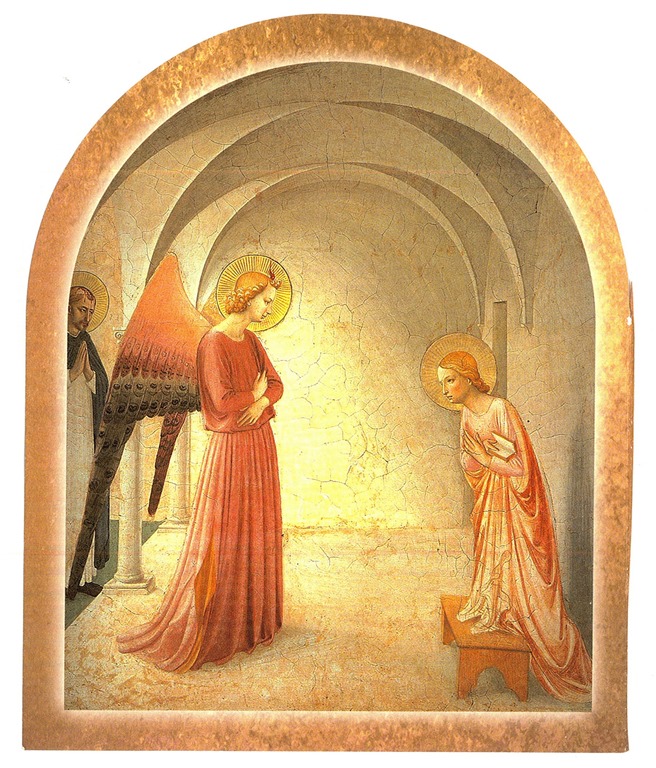
The Annunciation (Fra Angelico)

A simple method to pray the Rosary without distractions


– Preamble: warning of the Blessed Virgin Mary to the world

In conclusion, we will recall these words, spoken by Sister Lucy of Fatima to Father Fuentes in 1959 (Messagero del Cuore di Maria, nos. 8-9, August-September, 1961):

” – She told me this three times:

“Firstly; she stated that the devil is engaged in the decisive battle, that is to say, the final battle, from which one will emerge the victor or the vanquished: either we are with God or we are with the devil.

“The second time, she repeated to me that the ultimate remedies given to the world are: the holy Rosary and devotion to the immaculate Heart of Mary. The ultimate signifies that there will be no others.

“The third time, she told me that the other means, scorned by men, having been exhausted, she gives us in trepidation the last anchor of salvation which is the Blessed Virgin in person. The Lady said again that if we do not listen and if we still offend, we will no more be forgiven.

“Father (Lucy said to me), we must urgently take heed of the terrible reality. We don’t want to frighten souls, but this is an urgent appeal to reality. Since the Most Blessed Virgin has given so great a power to the Rosary, no problem exists, material or spiritual, national or international, which cannot be resolved by the Holy Rosary and by our sacrifices. To recite the Rosary with love and devotion will allow us console Mary and wipe away the many, many tears of her Immaculate Heart.”


– A method to pray the Rosary without distractions

Have you ever heard this episode from the life of St. Francis de Sales? The illustrious bishop of Geneva had promised his horse to a brave peasant, provided he could recite one Our Father without distraction. Having barely arrived at “give us this day our daily bread…” the poor man stopped to ask if the saddle and bridle were included!

Who can boast of never experiencing any distractions during prayer? The Blessed Virgin, knowing the difficulties of her children, has given us through St. Dominic a very effective way to fight against dissipation in prayer. The Rosary, with its beads linked together, gives us a tangible reminder that we are in the act of praying. However, we must know how to use it. One method of reciting the Rosary suggested by St. Louis Marie Grignon-de-Montfort (but coming from the Middle Ages) is to precede each Hail Mary with a different thought relating to the mystery. This does not add much time to the recitation of the Rosary (contrary to what one might think), and it helps us to refocus our attention.

Here is an example of this method as applied to the Joyful Mysteries:

THE ANNUNCIATION

1. The Blessed Virgin withdraws to a corner of the house to meditate on the Scriptures.

2. She reads the passage from Isaiah (7:14), “Behold a virgin shall conceive and bear a child…” and she begs the Lord to send the Messiah.

3. The Angel Gabriel appears and greets her by saying, “Hail full of grace.”

4. “Full of grace means she was preserved from all sin from the first moment of her existence.

5. She was conceived without original sin and never committed the slightest fault, even venial, neither through weakness, nor through surprise, nor through negligence.

6. The Blessed Virgin, who understands the meanings of his words, is troubled.

7. She knows that she is sinless, but it would be unthinkable for her to glorify herself.

8. It would be unthinkable for her to be greeted by an angel; who is by nature superior to men.

9. The angel says to her, “Behold thou shalt conceive in thy womb, and shall bring forth a son…And of his kingdom there shall be no end.”

10. She understands that she has been chosen to be the Mother of God.

THE VISITATION

1. The Angel Gabriel announces that Elizabeth has also conceived a child.

2. The Blessed Virgin, not thinking of herself, thinks only of her aged cousin.

3. She begins the tiring journey under the watchful protection of St. Joseph.

4. On arrival, the Blessed Virgin greets her cousin.

5. At the sound of the Blessed Virgin’s voice, St. John the Baptist is cleansed of original sin, and he leaps in the womb.

6. St. Elizabeth, filled with the Holy Ghost, exclaims: “Blessed art thou among women, and blessed is the fruit of thy womb…”

7. The Blessed Virgin gives all the glory to God.

8. “My soul magnifies the Lord….”

9. The more we glorify the Blessed Virgin, the more God is glorified.

10. The Blessed Virgin remains three months in humble service to her cousin.

THE BIRTH OF JESUS

1. The Blessed Virgin and St. Joseph travel to Bethlehem for the census.

2. Because the crowds come to be enrolled, there is no room in any inn.

3. Thinking back to his youth, St. Joseph remembers a cave away from the city.

4. He sweeps the ground a little and puts things in order, then he leaves to go search for firewood.

5. During his absence, the Blessed Virgin prays deeply, waiting for the great mystery about to happen.

6. She enters into a state of ecstasy.

7. She awakens and there in her arms she sees the most beautiful baby the world has ever seen.

8. She has experienced no pain. Her soul is filled with unspeakable joy.

9. She contemplates the radiant Child, and she recognizes there her own features.

10. St. Joseph returns; upon seeing the Child, he falls to his knees to adore Him.


PRESENTATION OF THE CHILD JESUS IN THE TEMPLE

1. Forty days after His birth, the Blessed Virgin and St. Joseph carry the Infant Jesus to the Temple to present Him to the Lord.

2. They give five shekels of silver to “redeem” the Child. (Numbers 1 8:16).

3. They also bring a pair of turtledoves for the sacrifice prescribed to women after birth. (Leviticus 12: 1 et seq.)

4. The old man Simeon, moved by the Holy Ghost, goes to the Temple.

5. He sees the Holy Family and recognizes Jesus as the awaited Messiah.

6. “Now thou dost dismiss Thy servant, O Lord, according to Thy word in peace; because my eyes have seen Thy salvation.”

7. Simeon blesses the Holy Family.

8. He prophesizes: “Behold this Child is set…for a sign which shall be contradicted,” that is to say, now every man will be either for Him or against Him.

9. To Our Lady he says, “A sword will pierce your soul.”

10. The Blessed Virgin keeps all these things in her heart.


RECOVERY OF THE CHILD JESUS IN THE TEMPLE

1. As Jesus is now twelve years old, the Blessed Virgin and St. Joseph have taken Him to Jerusalem to celebrate Passover.

2. They are part of a group of pilgrims from Nazareth. Men and women and walk separately during the day.

3. During the return trip, St. Joseph thinks that Jesus is with the Blessed Virgin, and Our Lady thinks that Jesus is with St. Joseph.

4. In the evening, after having searched among all the pilgrims and not finding Jesus, they retrace their steps.

5. The Blessed Virgin knows that Jesus must suffer and die, but she does not know when.

6. This uncertainty is torture for her.

7. Jesus asks questions of the rabbis about the coming Messiah.

8. It was not to learn anything, but rather to show them that they themselves had misconceptions about the subject.

9. He quotes passages of Scripture that teach that the Messiah will have to die to save us from our sins, and not to assure world domination by the Jews.

10. The Blessed Virgin and St. Joseph find Jesus among the amazed and confused rabbis.

(To be continued with the sorrowful and glorious Mysteries)

Gifts of the Magi


Gifts of the Magi

A meditation for the Feast of Epiphany

With Saint Thomas Aquinas

“Opening their treasures, they offered Him gifts: gold, frankincense, and myrrh.” (Matth. II, 11.)

Ever since the birth of Christ, and perhaps before the Saviour’s birth, gold was considered precious and as something greatly to be prized.  St. Matthew (II, 11) tells us of the wise men who offered the Saviour gifts of gold, frankincense, and myrrh.  “Entering into the house, they found the Child with Mary, His Mother, and falling down they adored Him.  Opening their treasures, they offered Him gifts: gold, frankincense and myrrh.”

– In a spiritual sense gold means heavenly wisdom.  The wise men were called wise because they followed the star, found the Saviour, gave Him their gold (in place of hoarding if), for they recognized Jesus as the Giver of all good gifts and realized that whatever good things they had were from God.  To recognize that important fact and to appreciate it is the highest wisdom and more precious to us than gold and silver.

– The Magi also brought frankincense to the Crib of Bethlehem and offered it to the world’s Redeemer.  Frankincense is a fragrant inflammable resin, burnt as incense, producing a sweet smelling odor.  In the spiritual order it signifies a devout prayer.  Hence King David, the royal Psalmist says, “O Lord, hear my voice, and let my prayer be directed as incense in Thy sight.” (Ps. CXL, 2.)  To have our prayers thus directed to God, they must be fervent and inflamed with the fire of charity.

– Myrrh is the aromatic gummy resin of Balsamodendron.    Myrrh that grows in Arabia and Abyssinia and is of an agreeable or spicy nature.  By Myrrh, in the spiritual sense, is understood the mortification of the flesh (so much needed in this age of luxury, ease and up-to-date comfort).  Wherefore, we read in Canticles (V, 5) “I arose up to open to My Beloved.  My hands dropped with myrrh and my fingers were full of the choicest myrrh.”  In these words the Church mystically describes Christ to those who know Him not, that is, to infidels; in order to convert them to the true faith.

By the visible things namely, gold, frankincense and myrrh when considered in a spiritual manner, we rise to a knowledge of the invisible things of God; and only then do we realize how much we need heavenly wisdom, devout prayer and mortification of the flesh. These three are the spiritual gold of the human soul.

(The Humanity of Christ.)

(From: Saint Thomas Meditations for every day, by Fr E.C. McEnery O.P., Columbus [Ohio], Long’s College book company, 1951)

Friends and Benefactors Letter number 21, January 2016 – The Importance of Principles, Part II


Letter from the Dominicans of Avrillé

No. 21, January 2016

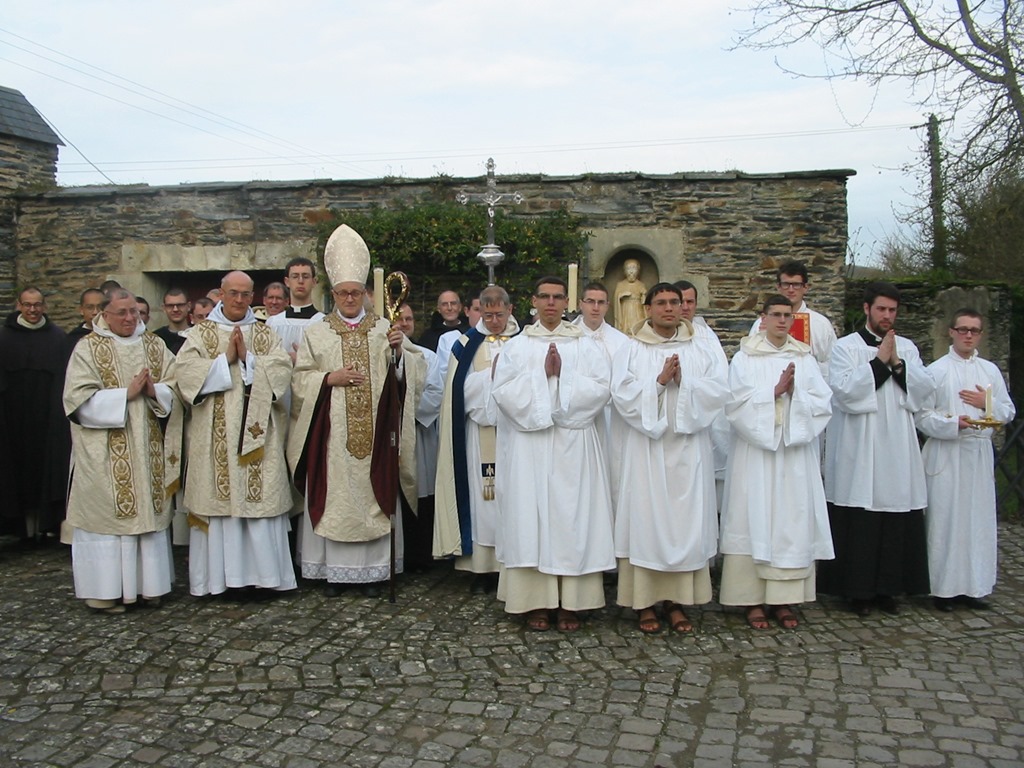
Group photo with H. E. Bishop Faure and our three newly tonsured Brothers (see chronicle).


The Importance of Principles (Part II)

Maintaining Principles in the Modern World

Dear Friends and Benefactors,

Escaping the seduction of false principles is especially difficult nowadays because these false principles are being taught to the youth beginning at elementary school (thanks to the pseudo-educational system), continually hammered out by the media, and largely accepted by the Conciliar Church:

“The battle is mainly a battle of doctrines. Your resistance, dear brothers, consists therefore in being firm in your minds against the seduction of false and misleading principles. […]  When I ask the wise [men] of this era to identify the worst hardship of modern society, they reply unanimously that mankind is becoming weak and soft.  This reply has even become cliché.  However, we must go further, and ask the ultimate question. […]  Where does this weakness come from?  Isn’t it the natural and inevitable consequence of doctrinal weakness, weakness in belief, and, to be more exact, weakness in the Faith?  After all, courage has no reason to exist if it isn’t at the service of a conviction.  The will is a blind faculty when it is not enlightened by the intellect.  One cannot walk with assurance in the darkness of night, nor even in merely dim daylight. […]  Dear brethren, today, more than ever, the primary strength of the wicked is the weakness of the good.  The core of Satan’s reign among us is the toning down of Christianity in Christians”  (Cardinal Pie. Panégyrique de Saint Émilien, November 8, 1859.  Note that Saint Pius X cited the last sentence of the above passage, in his sermon on December 13, 1908, when he beatified Saint Joan of Arc).

The Importance of Education, Especially in the Family

It is especially in the home that moral principles are acquired.  These principles are indelible when they are learned right from childhood – which is the reason why the Revolution constantly wages war against the family, in order to remove any obstacle to the spreading of its errors:

“Nowadays [in 1910!] we have become helpless witnesses to such acts which – if we were living in the ancient times of paganism – even the barbarians and savages would have violently opposed.  Everywhere in France, schools in which the young are taught to know, love, and adore God, are being closed by a government declaring openly that its goal is to establish a nation of atheists.  We are helpless to remedy the situation because we no longer have firm principles solidly established in our souls.  Instead, we have but vague and unstable ideas, incapable of giving us the strength and energy we need.  Why are our ideas unstable?  It is because the higher, fundamental principles have not at all been inculcated in the souls of children by parents, who, having been formed by these principles, have not transmitted them.  In a word, our families no longer have the sense of tradition.”   (Msgr. Henri Delassus. L’Esprit familial dans la maison, dans la Cité et dans l’État. Lille, France. Éditions Deslcée de Brouwer, 1910. pp. 147-148).

The Force of Principles

There is a force attached to the confession of the truth.  If we know good principles well, and if we count on the grace of Our Lord to make these principles known, there will always be men of good will to listen and understand:

“Today more than ever – and let it be understood rightly – society needs strong and consistent doctrines.  Even though ideas are falling apart everywhere, asserting the truth can still be done in society, provided that this assertion of truth be firm, substantial, and without compromise.  The exchanges between men are becoming more and more sterile; each one seems to hold on to a part of truth, without grasping the whole.  As in the early days of Christianity, it is necessary now that Christians attract the attention of all, by the unity of their principles and judgments.  They have nothing to borrow from this chaos of negations and endless experimentation that testify so eloquently to the powerlessness of modern society.  This society is only living off the rare remnants of the former Catholic civilization that the Revolution has not yet taken away and which God’s Mercy has preserved from destruction.  It is up to you, convinced Catholics, to show yourself as you are.  The world may fear you at first, but be convinced that it will come back to you.  However, if you try to flatter these men by using their language, you will amuse them only for a time.  In the next moment they will forget you because you have not made a serious impression on their minds.  They will see in you the image of themselves; and since they have no trust in themselves, they won’t have much more confidence in you.  There is a grace attached to the full and entire confession of the Faith.  This grace, according to Saint Paul, is the salvation of those who accomplish this confession; and experience shows that such a confession is also the salvation of those who witness it.  Be Catholic and nothing other than Catholic.”   (Dom Prosper Guéranger, O. S. B. Le Sens Chrétien de l’Histoire. The Christian Sense of History. Cited in Le Sel de la Terre: issue 22 – Fall 1997, p.196).

Community Chronicle

September 5th – 6th:  Fathers Innocent-Marie, Louis-Marie, Reginald and Terence, accompanied by a group of the high school boys, attend the yearly book fair at Chiré-en-Montreuil (the Publishing house which handles our Éditions du Sel).

September 7thStart of the school year for Saint Philomena Elementary School, and Saint Thomas Aquinas High School.  Among the extracurricular activities for the high school boys:  weekly study groups to give them a formation for the doctrinal, political and economic combats of tomorrow.  The number of volunteers having grown from last year, there are now three different groups, under the direction of Fathers Innocent-Marie, Reginald and Terence.

September 14th:  Start of the school year for our three clerical brothers.  On the same day, according to the Constitutions of our Order, the Regent of Studies (Fr. Emmanuel-Marie) and the Master of Novices (Fr. Marie-Dominique), renew their Tridentine Profession of Faith, the anti-modernist oath, and the oath to always hold firmly to the doctrine of Saint Thomas Aquinas.

September 26th:  “Our Lady of Fatima Youth Club” has its first meeting of the year, with Fathers Angelico and Hyacinthe-Marie.

October 3rd: Father Prior and Father Angelico represent the community at the official blessing by Bishop Faure of Saint Louis-Marie Grignon de Montfort Seminary in nearby Avrillé.

October 16thEntry of our three new postulants:  Filip (Poland), Tiago (Brazil), and Maximilien (France).

October 24th to 11th November:  Fathers Marie-Dominique and Angelico fly to the U.S. to preach two retreats with Father Zendejas on the 15 Mysteries of the Rosary.  In all, about 35 men and woman from all over the U.S. followed the retreats, and will now hopefully know how to get more out of their daily Rosary.  These retreats were also the occasion for five postulants to be received as novices in the Third Order.  For the Feast of Christ the King, the Fathers replaced Fr. Zendejas at his chapels in Connecticut and Pennsylvania.  Before returning to France, the Fathers made a small detour to Minnesota for Sunday Masses, and a few conferences.  A large number of faithful came out, despite the distance.  In each of the places visited, the zeal and fervor of the faithful was remarkable.

November 21st: Meeting for the preparation of next summer’s “John Vaquié Days” (yearly doctrinal session on the tactics of the enemies of the Church).  Three graduates from Saint Thomas Aquinas Boys’ school begin to take an active role in organizing this event, which gives us hope for the future!

December 1st:  As on every first and third Tuesday of the month, Fr. Angelico meets with a group of faithful in the Friary Library for the adult catechism class.  This year’s theme: Old Testament History.

December 8th:   Second annual Mass and candle-light Procession in the city of Angers, in honor of the Immaculate Conception of Our Lady.

On the same day, Pope Francis inaugurated the “Year of Mercy” with a light show at the Vatican.  The show, jointly sponsored by the World Bank, had a “New Age” environmental theme, in conjunction with the Pope’s recent Encyclical on ecology.  We cannot participate in this “Jubilee”, whose sole purpose is to celebrate the 50th anniversary of Vatican II and the new humanistic religion it has ushered in.  For a more detailed refutation of those who advocate participating in the “Year of Mercy”, please go to <https://dominicansavrille.us/should-we-participate-in-the-jubilee-of-mercy/>

December 22nd:  Feast of the Patronage of the Blessed Virgin Mary over the Order of Preachers.  Bishop Faure confers the ecclesiastical tonsure to our three clerical Brothers.

Brothers Alain, Louis-Bertrand and Agostinho offer their candles to the Bishop as part of the ceremony.

December 25th: After the solemn ceremonies of the Dominican Christmas Liturgy*, the afternoon is reserved for the traditional Christmas recreation.  As each year, Christmas carols were sung in French, English, Portuguese, Polish and Flemish (the five most common mother tongues among the members of our very international community), but this year there was something new:  it’s the first year we were privileged with the presence of a Bishop (H.E. Faure)!

*The Dominican liturgy has conserved a few practices that have been abandoned in the Roman rite, for example, the beautiful sequence Laetabundus that is sung just before the Gospel.

PLEASE NOTE:

THE UNITED STATES IRS HAS NOW APPROVED OUR TAX EXEMPT STATUS

To send a donation:

— In the U.S.:

Dominicans of Avrillé, Inc.

P.O. Box 23

Newman Lake, WA. 99025-9998


— In Canada:

The Association of St. Dominic

Canadian Imperial Bank of Commerce

201-21 Street East

Saskatoon, Saskatchewan

S7K OB8 Canada

Please specify:

CAN$: acc.#40-91531


— In the U.K.:

The Association of St. Dominic

The Royal Bank of Scotland plc, Edinburgh Comiston Branch

17 Comiston Road

Edinburgh EH10 6AA

Please specify:

Acc # 00105564

For more information write to:

Couvent de la Haye-aux-Bonshommes

49240 Avrillé, France

What should we make of the book The Poem of the Man God by Maria Valtorta?


What should we make of the book The Poem of the Man God by Maria Valtorta?

To answer to questions which were asked of us about Maria Valtorta, we publish here a text coming from Le Sel de la terre n° 7 (doctrinal review of the Dominicans of Avrillé).

For more details, you can consult the book of Fr Herrbach: “Des visions sur l’Évangile” on the website: http://www.clovis-diffusion.com/

Maria Valtorta died in 1961 “in an incomprehensible physical isolation” (in an insane asylum).

Her principal work The Poem of the Man God, which was written in the years from 1943 to 1947, took up 10,000 pages of note-books.

Her confessor Father Migliorini, claims to have been received in audience with Pope Pius XII alongside Father Berti, in February 1948 and the Pope is supposed to have said to them to publish this work, adding ” Whoever reads it, will understand“.  This oral authorisation of the Pope seems very unlikely: The Pope could only have given the authorisation of the work if he had read it and been assured of its orthodoxy; but how would the Pope have found the time to read these 10,000 pages?  This authorisation appears even less credible when the Holy Office forbade the work definitively (with no possible correction) one year later in February 1949.  The first four volumes were however published without Imprimatur from 1956 to 1959.  On the 16th of December 1959, the edited books were put on The Index [Editor: The Index of Forbidden Books].   The Osservatore Romano (official newspaper of the Vatican) published the placement on The Index accompanied with an article justifying the condemnation.  Here are some extracts:

“The four Gospels present us with a Jesus humble and full of reserve; His speaking is sober, incisive but supremely efficacious.  On the contrary in this sort of romantic History [Editor:  i.e. The Poem of the Man God], Jesus is excessively loquacious and resembles a man of propaganda, always ready to proclaim Himself the Messiah and Son of God, and to give out lessons of theology, using the same terms that a professor of theology would use today.

In the Gospel narratives, we admire the humility and the silence of the Mother of Jesus.  On the contrary for the author of this work, the most blessed Virgin Mary with the talkativeness of a modern lawyer, is always present everywhere and always ready to give lessons of Marian theology, perfectly up to date with the latest current studies of specialists on the matter…

Some scenes are rather indecent and make us think of scenes from a modern novel.  We will only give a few examples, such as the confession made to Mary by a certain Aglae, a woman of ill-repute (1st volume, p.790 and after4);  the not very edifying narrative from pages 887 and onwards in the first volume;  a ballet executed in an immodest fashion before Pilate at the pretorium (volume 4, p. 75) etc…

To finish let us point out another strange and imprecise affirmation where it is said of the Madonna, “You, all the time that you will be on this earth, you will be the second after Peter, in the ecclesiastical hierarchy. [It is we who underline, says the review]”

Here are some examples of the errors and improprieties of this book

  • Our Lord thinks that words tire now and we must have recourse to visions… of Maria Valtorta; 
  • The tree of life in the terrestrial paradise is only a symbol; 
  • The sin of Adam and Eve consisted in the use of marriage in a spirit of lust; 
  • Saint Anne gave birth without pain; 
  • Our Lady brags of her humility and her calm; 
  • She says that she redeemed women through her maternity; 
  • She said that she saw God at her creation; 
  • Satan became flesh in the form of Judas.

One can note numerous contradictions with the Gospel, for example:

  • Our Lord is supposed to have sucked with avidity the vinegar given by the soldier;
  • On the Cross Our Lord did not cease to cry out “Mommy!” and she replied: “Yes, my treasure, I am here”; 
  • Our Lady gets angry, cries out and becomes “almost” delirious after the death of her Son;
  • and this is not to mention the numerous sensualities which are spread throughout the work.

Let us finish by citing a talk by Archbishop Lefebvre at a retreat, where he expresses his reserve regarding Maria Valtorta:

It is better for us […] not to spend too much time on the material details of the life of Our Lord. […] These books which present themselves as revelations of the Life of Our Lord, in my opinion, can be a danger, precisely because they represent Our Lord in a too concrete manner, too much in the details of His life.  I am thinking of course of Maria Valtorta.   And perhaps for some this reading can do good, it can bring them close to Our Lord, to try to imagine what would have been the life of the Apostles with Our Lord, the life at Nazareth, the life of Our Lord as the visits of the cities of Israel.

But there is a danger, a great danger; that is to humanize too much, to concretize too much, and to not sufficiently show the face of God, in this Life of Our Lord.  This is the danger.  I do not know if we should recommend so much to people the reading of these books, if they are not forewarned.  I do not know if that would raise them up and make them know Our Lord, such as He was, such as He is, such as we should know Him and believe Him to be.5

Last advice : Rather than read these novels where errors abound, it would be better to read Holy Scripture with good commentary based on the Fathers of the Church6, or even good lives of the saints7.

(From Le Sel de la terre, n° 7)